
From Relaunch to Graduation: SUNO Athletics Class of 2026 Fulfills the Promise
From walk-on athletes to graduating seniors, the Knights' Class of 2026 reflects a program built on access, accountability, and academic purpose.

More Than Athletics: SUNO Celebrates 25 Student-Athletes at 2026 Commencement
From walk-on athletes to graduating seniors, the Knights' Class of 2026 reflects a program built on access, accountability, and academic purpose.
Southern University at New Orleans celebrated 25 student-athletes during its 2026 commencement ceremony — a milestone that represents far more than a line on a statistics sheet. Every one of those graduates came to SUNO because of athletics. Some competed all four years. Others stepped away from the playing field before their eligibility expired. All of them earned their degrees.
That distinction matters deeply to Director of Athletics James A. Matthews, III, who has spent the past four years building a program rooted not just in wins and losses, but in life outcomes.
"Athletics was the door. Education was always the destination. Every student we recruited understood that from day one." — AD James A. Matthews, III
Among the 25 graduates are four names that hold particular significance in the story of SUNO Athletics: Jordan Harris, McKenna Harris, Devin Daniels, and Caleb Williams — members of the inaugural class that helped relaunch the Knights' athletics program in 2022. When SUNO revived its program four years ago, it was a vision built on possibility. These four were among the first to believe in it.
The Founding Four
In 2022, SUNO athletics was, in many ways, starting from scratch. The men's and women's basketball programs were being reestablished, and coaches were assembling rosters from a pool of student-athletes who were being asked to trust an institution still finding its footing. Jordan Harris and McKenna Harris, standouts on the women's basketball squad, were part of that first wave — young athletes willing to commit to something unproven because they saw something in SUNO's mission that resonated.
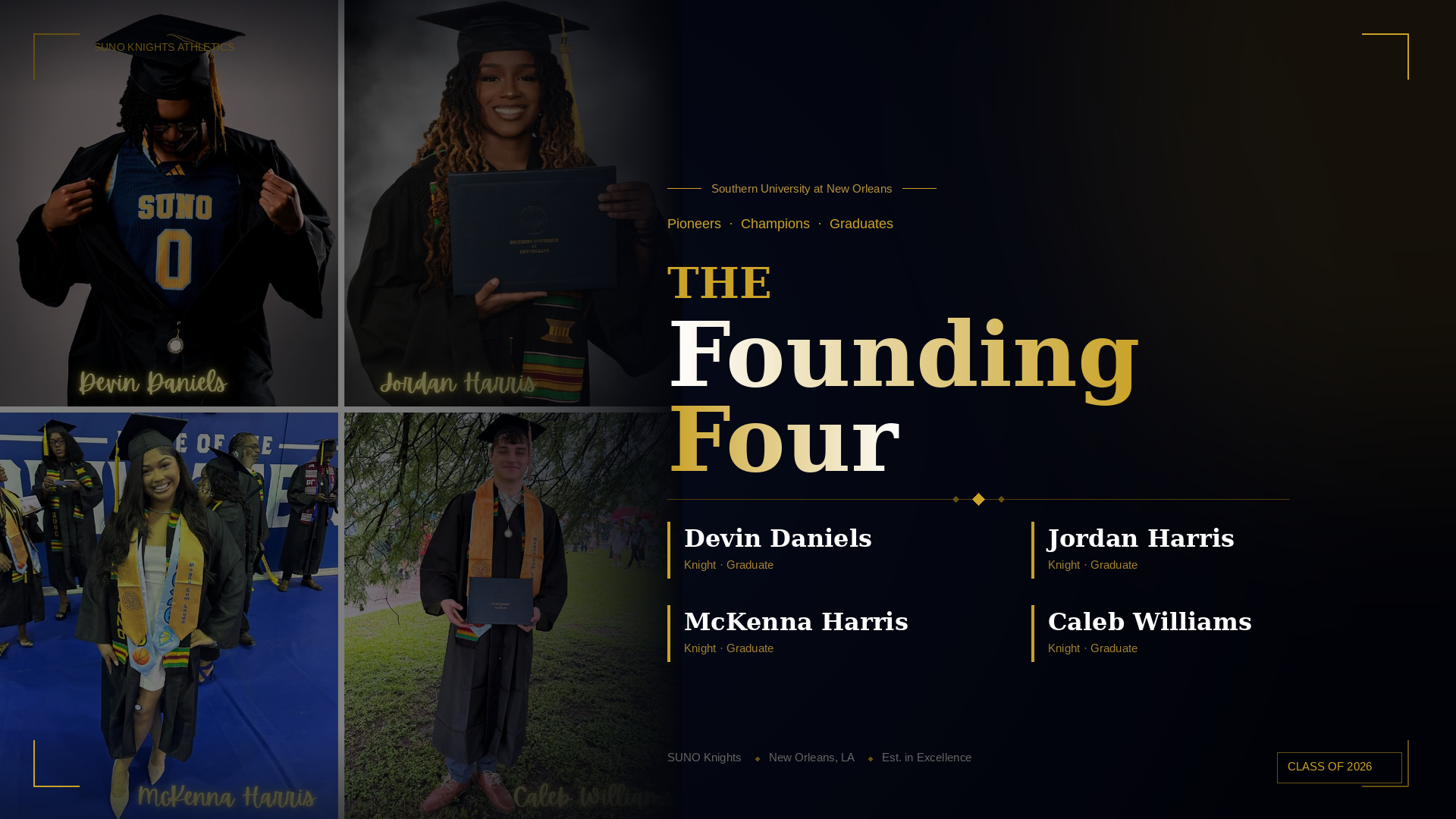
Devin Daniels and Caleb Williams joined them on the men’s basketball side, rounding out a small but determined group that would help set the cultural tone for the program that followed. They were more than athletes. They were proof of concept.
Each left a mark beyond their playing time. Harris and Daniels graduated with the highest cumulative GPAs in their respective programs — a distinction that reflects exactly the kind of student-athlete SUNO set out to recruit. And in their final season, Daniels and Williams delivered something the program had not seen since 2012: a conference championship title, an achievement many thought would take years longer to reach.
Now, four years later, all four walk across the commencement stage with degrees in hand.
"Those four students did something extraordinary. They came here when there was no blueprint, no tradition to follow — just a promise. They honored that promise every single day." — AD James A. Matthews, III
A Program Built on Access
SUNO Athletics closes out its fourth full year having retained 72 percent of its student-athletes — a figure that speaks directly to Matthews' founding philosophy. From the beginning, his approach to recruiting was never centered solely on athletic performance. It was centered on finding students who needed a pathway and giving them one.
"We recruit students who, in many cases, would not have had another opportunity to continue their education," Matthews said. "Athletics is how they get here. But what we build around them — academically, personally, institutionally — is what keeps them here and gets them to graduation."
That philosophy is supported by a growing body of national research. According to a 2021 study by Kate Moleski published by the Education Resources Information Center (ERIC), Black student-athletes in NAIA institutions were found to be more likely to complete their degrees than their peers, with graduation rates positively influenced by financial aid in the form of work-study. This is a finding that runs counter to patterns frequently observed in NCAA Division I revenue sports, where athletic obligations can sometimes work against academic progress.
For SUNO, operating within the NAIA framework appears to be a structural advantage — not just athletically, but academically.
Why Athletics Works as an Academic Engine
The research backing SUNO's model runs wide and deep. Participation in school sports has been consistently correlated with better academic and behavioral outcomes for athletes compared to non-athletes — with measurable implications for retention, college enrollment, and graduation success. At the college level, athletic participation at NAIA and Division I institutions alike is positively associated with academic performance, with student-athletes appearing both more likely to graduate and to carry higher GPAs than non-athlete counterparts.
Several mechanisms help explain that relationship. The structure inherent to athletic participation — practice schedules, travel, film study, team accountability — builds the time management and self-discipline that translate directly into academic habits. A 2024 study of 96 university-level student-athletes found that sports participation positively impacts academic self-regulation and engagement, particularly through enhanced time management, regardless of whether the athlete competes in a team or individual sport.
There is also a neurological dimension. Research from the University of British Columbia found that regular aerobic exercise increases the size of the hippocampus — the area of the brain central to memory and learning — while also improving sleep quality and overall mental health. The student-athlete's daily routine, by its nature, is one that supports cognitive performance.
Perhaps most critically, the support structures embedded in athletics programs serve as a powerful retention tool. More than two-thirds of student-athletes develop close relationships with at least one faculty member. More than 80 percent believe their coach genuinely cares whether they graduate. Studies have shown that regular use of athletic academic support services correlates with higher GPAs and graduation rates — and that without those built-in systems, athletes are measurably more susceptible to dropping out.
"The structure of athletics doesn't end on the court or the field. It follows them into the classroom, into the library, into every space where they have to perform under pressure." — AD James A. Matthews, III
Matthews has been intentional about ensuring those support structures exist at SUNO. The program's academic support systems, its coaching staff's emphasis on degree completion, and its culture of accountability have all been engineered to produce exactly the kind of outcome the Class of 2026 represents.
Athletics as an Enrollment Driver
The NAIA's Return on Athletics (ROA) research has consistently found that athletics ranks among the top three factors — alongside academics and campus environment — in influencing the enrollment decisions of small-college student-athletes. For NAIA institutions, which are predominantly small colleges like SUNO, that data carries real institutional weight.
The NAIA uses ROA findings to help member schools implement specific process changes that support institutional priorities, providing analytics tools that show how adjustments to an athletics program can affect overall institutional health — enrollment numbers, retention rates, campus culture, and financial sustainability.
For SUNO, the numbers are beginning to tell that story. Twenty-five graduates in four years from a program that did not exist before 2022 is not a small thing. It is a proof point that athletics, designed and managed with intentionality, can function as a genuine engine for institutional mission.
"When you invest in a student-athlete, you're not just investing in someone who can play. You're investing in someone who has already demonstrated they can commit to something bigger than themselves." — AD James A. Matthews, III
The Class of 2026
The 25 graduates crossing the stage this spring represent every sport in the SUNO Athletics portfolio. Some were four-year contributors. Others transferred in and completed their degrees at SUNO after stepping away from competition. A few arrived as athletes and rediscovered themselves as students first, finding their footing academically even as their athletic paths changed course.
Baseball
Bowens, Miles
Cantu, Caden
Carter, Josh
Edmondson, Kerrigan
Flanigan, Jordan
Garrett, Bryce
Jimenez, Dylan
Lantigua, Damian
Robinson, Derrick
Men’s Basketball
Daniels, Devin
Richardson, Alfred
Rogers, Jakhari
White, Tony
Williams, Caleb
Women’s Basketball
Bell, Jashyree
Cornelious, Hannah
Garrett, Brianna
Hadley, Savannah
Harris, Jordan
Harris, McKenna
Jack, Kaylan
McNeal, Zaire
Sylvas, Tierra
Women’s Volleyball
Clark, A’Lon
Jenkins, Amani
What unites them is the common thread that Matthews and his staff wove from day one: the expectation that coming to SUNO through athletics meant committing to the full opportunity — not just the games.
"These 25 graduates are not a coincidence," Matthews said. "They are the result of a deliberate, values-driven approach to what athletics should be at an institution like ours. They are why we do this."
As SUNO Athletics closes out its fourth year of operation and looks toward what comes next, the Class of 2026 stands as its most compelling argument — not for what the program has won, but for what it has built.
About SUNO Athletics The Southern University at New Orleans Knights Department of Athletics emphasizes competitive excellence, academic achievement and community engagement. For the full 2025–26 schedule, rosters, and ticket information, visit sunoathletics.com and follow @sunoathletics on social media. References Moleski, K. (2021). NAIA student-athlete graduation rates and the role of financial aid. Education Resources Information Center (ERIC). https://eric.ed.gov/ National Association of Intercollegiate Athletics. (n.d.). Return on athletics (ROA) research. NAIA. https://www.naia.org/ Eitle, T. M., & Eitle, D. J. (2002). Race, cultural capital, and the educational effects of participation in sports. Sociology of Education, 75(2), 123–146. https://doi.org/10.2307/ Pascarella, E. T., Bohr, L., Nora, A., Desler, M., & Zusman, B. (1994). Intercollegiate athletic participation and freshman-year cognitive outcomes. Journal of Higher Education, 65(4), 369–387. https://doi.org/10.1080/ Stambulova, N., Alfermann, D., Statler, T., & Côté, J. (2024). Sports participation, academic self-regulation, and time management in university student-athletes. International Journal of Sport and Exercise Psychology. https://doi.org/10.1080/ Snyder, A. R., Martinez, J. C., Bay, R. C., Parsons, J. T., Sauers, E. L., & Valovich McLeod, T. C. (2010). Health-related quality of life differs between adolescent athletes and adolescent nonathletes. Journal of Sport Rehabilitation, 19(3), 237–248. https://doi.org/10.1123/jsr. Erickson, K. I., Voss, M. W., Prakash, R. S., Basak, C., Szabo, A., Chaddock, L., Kim, J. S., Heo, S., Alves, H., White, S. M., Wojcicki, T. R., Mailey, E., Vieira, V. J., Martin, S. A., Pence, B. D., Woods, J. A., McAuley, E., & Kramer, A. F. (2011). Exercise training increases size of hippocampus and improves memory. Proceedings of the National Academy of Sciences, 108(7), 3017–3022. https://doi.org/10.1073/pnas. Gayles, J. G., & Hu, S. (2009). The influence of student engagement and sport participation on college outcomes among division I student athletes. Journal of Higher Education, 80(3), 315–333. https://doi.org/10.1080/ Wolverton, B. (2008, November 27). Athletes’ graduation rates top those of other students. The Chronicle of Higher Education. https://www.chronicle.com/